How Specific and Contextual Effects Shape Outcomes in Musculoskeletal Rehabilitation
This large meta-analysis examined how much of the benefit from common physical therapy interventions for musculoskeletal pain (mobilization, manipulation, soft tissue techniques, taping, dry needling, exercise therapy) is due to the specific treatment effect versus nonspecific and contextual factors (often labeled placebo effects).
Sixty-eight studies were included in the review (participants: n = 5238), and 54 placebo-controlled trials (participants: n = 3793).
The key metric used was the Proportion Not Attributable to the specific intervention (PCE) — essentially, how much of the improvement could not be directly linked to the active mechanism of the treatment.
📊 Pain Outcomes
For pain intensity:
- Mobilization: 87% of the overall effect not attributable to specific effects
- Soft tissue techniques: 81%
- Manipulation: 74%
- Dry needling: 75%
- Taping: 69%
- Exercise therapy: 46%
A large PCE (Proportion not attributable to the specific Effects) means that most of the observed treatment benefit cannot be explained by the specific mechanism of the intervention itself.
This means that for most passive/manual treatments, a large portion of the observed pain relief was explained by contextual and nonspecific effects rather than the direct mechanical mechanism.
Exercise therapy showed the lowest PCE, suggesting a relatively stronger specific effect compared to passive treatments.
📉 Disability Outcomes
For disability:
- Taping: 64% not attributable to specific effects
- Mobilization: 47%
- Manipulation: 40%
Again, contextual and nonspecific factors played a substantial role.
🧠 Manual vs Nonmanual Placebo
Interestingly:
- Trials using nonmanual placebo (e.g., detuned devices) had even higher PCE (~83%)
- Trials using manual placebo had slightly lower PCE (~70%)
This suggests the ritual, sophistication, and expectations attached to treatment significantly influence outcomes — regardless of whether the treatment is manual or device-based.
🧩 What This Means Clinically
1️⃣ Treatment Effects Are Multifactorial
Pain and disability improvements are not driven solely by:
- Biomechanical correction
- Tissue change
- Structural modification
They are strongly influenced by:
- Patient expectations
- Therapeutic alliance
- The meaning of treatment
- Treatment ritual
- Provider confidence and communication
- Natural recovery and regression to the mean
Manual therapy and passive techniques are not “ineffective” — but their effects are not purely mechanical.
2️⃣ Contextual Effects Are Powerful — and Ethical to Use
Contextual effects are not deception.
They include:
- Clear, confident explanations
- Positive framing
- Skilled touch
- Patient feeling heard and valued
- Visible therapist engagement
These can amplify outcomes — especially for pain.
The key ethical point:
Contextual enhancement should occur within evidence-based care, not as a substitute for active rehabilitation.
3️⃣ Exercise May Have More Specific Effects
Exercise therapy showed a lower PCE (~46%), suggesting:
- A greater proportion of its effect may be directly related to its physiological mechanisms.
- Active treatments may produce more durable, mechanistically driven change.
However, exercise is not immune to contextual effects either.
4️⃣ There Is No “Inactive” Placebo in Physical Therapy
Even sham treatments produce meaningful change.
This highlights:
- The difficulty of isolating pure mechanical effects.
- The importance of recognizing that all clinical encounters carry meaning.
🏥 Practical Clinical Takeaways
✔️ Don’t ignore contextual factors — optimize them.
- Use confident, positive language.
- Set clear expectations.
- Build rapport intentionally.
- Frame treatments constructively.
✔️ Combine passive and active strategies.
Passive treatments may:
- Reduce sensitivity
- Increase short-term movement confidence
- Prepare patients for exercise
Active rehabilitation is essential for long-term capacity building.
✔️ Move beyond purely structural narratives.
Given the high PCE for manual techniques, it is unlikely that structural correction alone explains outcomes.
✔️ Communicate modern pain science carefully.
You can acknowledge:
- Touch matters.
- Mechanical input matters.
- The nervous system responds to that input.
- Recovery is multifactorial.
🎯 Big Picture
Musculoskeletal pain improvement is complex.
Specific treatment effects + contextual effects + nonspecific recovery processes all interact.
The most effective clinicians likely:
- Deliver technically sound interventions
- Communicate confidently
- Foster therapeutic alliance
- Integrate exercise and education
- Understand expectation and meaning
Manual therapy is not “just mechanical.”
But it is not “just placebo” either.
It operates within a biopsychosocial system where context amplifies physiology.
And that insight should shape how we treat — and how we explain treatment — going forward.
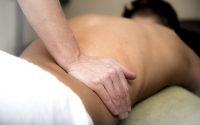
Beyond Biomechanics and Pain Science: The role of human touch

Decreasing post-operative adhesions with Manual Therapy
Fascial Unwinding Cancels Torsional Forces
About The Author
